Company car allowance calculator
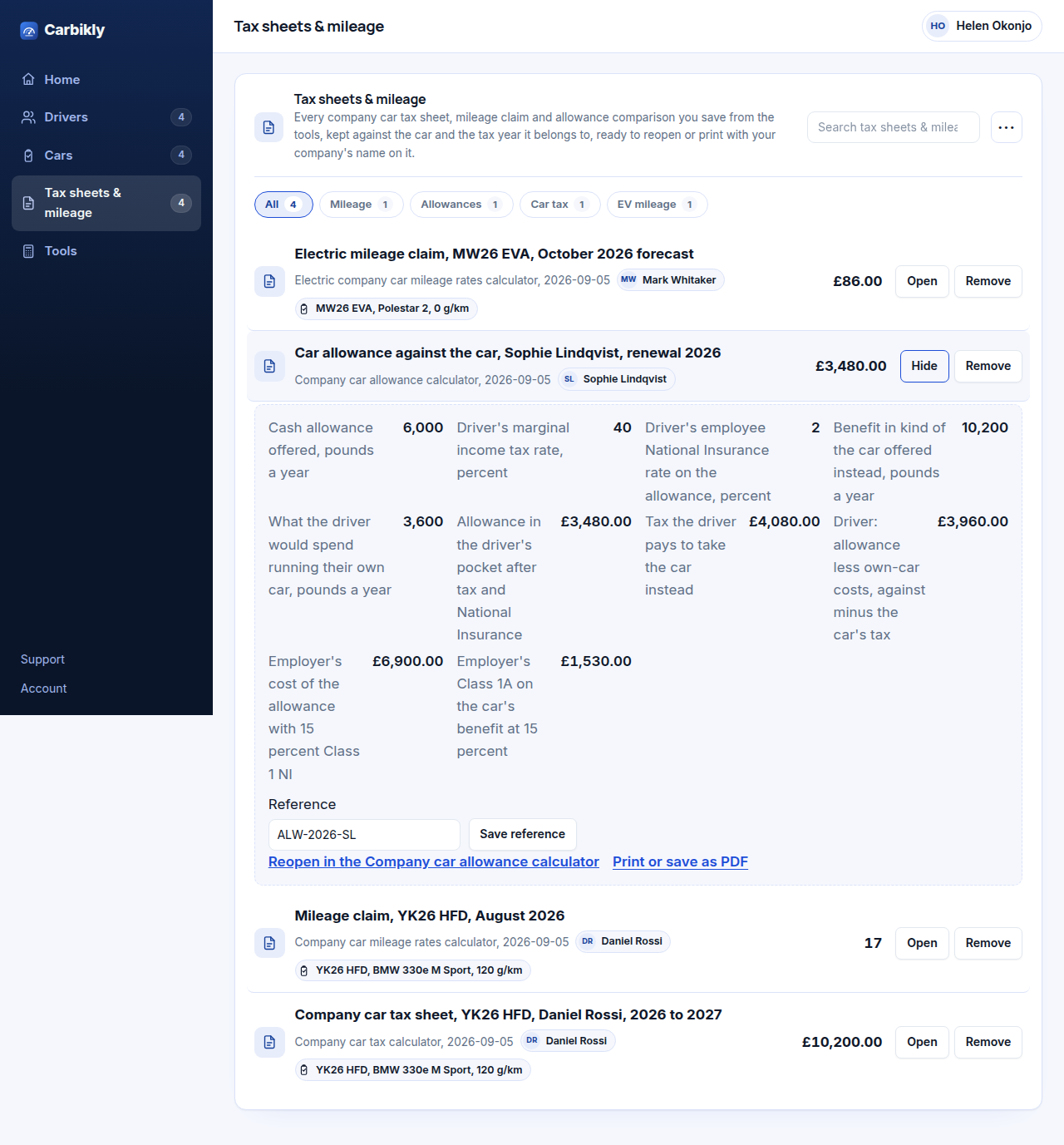
- Allowance in the driver's pocket after tax and National Insurance
- £3,480
- Computed on this page from the inputs below
- Tax the driver pays to take the car instead
- £4,080
- Computed on this page from the inputs below
- Driver: allowance less own-car costs, against minus the car's tax
- £3,960
- Computed on this page from the inputs below
- Employer's cost of the allowance with 15 percent Class 1 NI
- £6,900
- Computed on this page from the inputs below
Each figure on this page is HMRC's own method applied to the inputs you typed, with the rate and the page it was read from cited beside it and the date it was read. Carbikly publishes no dealer price, no lease quote and no advice on which car to take: the worked example is there to be overwritten with your own list price and band, and the rates are gov.uk's on the date cited.
Email me this result
We will send you these figures and a link back to them. One email, nothing else unless you tick the box.
The figures above start from a worked example (£3,480). Change the list price, the band or the rate and the sheet reworks as you type, the way it will when the new rates land each April.
Download the Company car allowance calculator worked example (CSV)
A company car allowance is cash paid with salary instead of a car, and it is taxed as salary: income tax at the driver's marginal rate and employee National Insurance come off it, and the employer pays Class 1 National Insurance on top.
The car, by contrast, costs the driver income tax on the benefit in kind and costs the employer Class 1A on the same figure, and the car comes with insurance, servicing and depreciation paid. So the comparison is never allowance against car; it is allowance after tax and National Insurance, less what the driver would spend running their own car, against the tax on the car's benefit.
This worksheet puts both sides on the page for the driver and for the employer, from the allowance offered, the driver's rate, the car's benefit in kind and the driver's own running costs.
Take the allowance offered, deduct income tax at the driver's marginal rate and employee National Insurance at the rate that applies to that slice of earnings, and what is left is the cash. From that comes what the driver would spend keeping a comparable car on the road: finance or depreciation, insurance, servicing, tyres.
Against it sits the car: the driver pays tax on the benefit in kind at the same marginal rate, worked on the company car tax calculator on this site, and spends nothing on the car's running costs.
For the employer, the allowance costs the cash plus Class 1 employer National Insurance, while the car costs its lease or depreciation plus Class 1A on the benefit; the sheet shows the National Insurance halves of both so the employer can add its own lease cost. A low-emission car with a low percentage usually beats the allowance for a higher-rate driver; a high-emission car rarely does.
What a fleet manager asks before trusting the Company car allowance calculator
Is a car allowance pensionable or counted for a mortgage? Usually it is paid through payroll as salary, so it is subject to PAYE and National Insurance, and many lenders treat it as income. Whether it is pensionable depends on the employer's scheme rules, which the sheet cannot know; ask payroll.
Can the driver claim mileage on their own car if they take the allowance? Yes: business miles in the driver's own car attract the approved mileage allowance, tax free up to 55p a mile for the first 10,000 miles and 25p after, and if the employer pays less the driver can claim mileage allowance relief on the difference.
Does Carbikly keep the comparison for each driver? No: the sheet runs in your browser and nothing leaves it. Carbikly Pro keeps each driver's allowance test against their record, beside the benefit in kind of the car they were offered, so the choice and the figure it was made on are still there when the next renewal comes round.